
AI Essay Feedback: How to Improve Your Writing (Without Cheating)
AI essay feedback tools read your draft and tell you what’s working and what isn’t — your thesis, structure, evidence, clarity, and grammar — in seconds, so you can revise before you hand it in. According to Wikipedia’s overview of automated essay scoring, these systems use natural language processing to evaluate writing at scale, which is the same technology under the hood of most feedback tools. Used the right way, an ai study tool for students acts like a patient writing tutor who reviews draft after draft without getting tired.
The key word is feedback. A good tool tells you how to make your essay better; it should not write the essay for you. This guide covers what these tools evaluate, how to turn their notes into a stronger draft, and where the line between help and cheating sits.

One principle up front: AI essay feedback is meant to help you improve your own writing, not to produce a paper you didn’t write. It is not a shortcut around the assignment, and its feedback can be generic or wrong — so you stay the author and the editor. That distinction runs through everything below.
What Is AI Essay Feedback (and How Does It Work)?
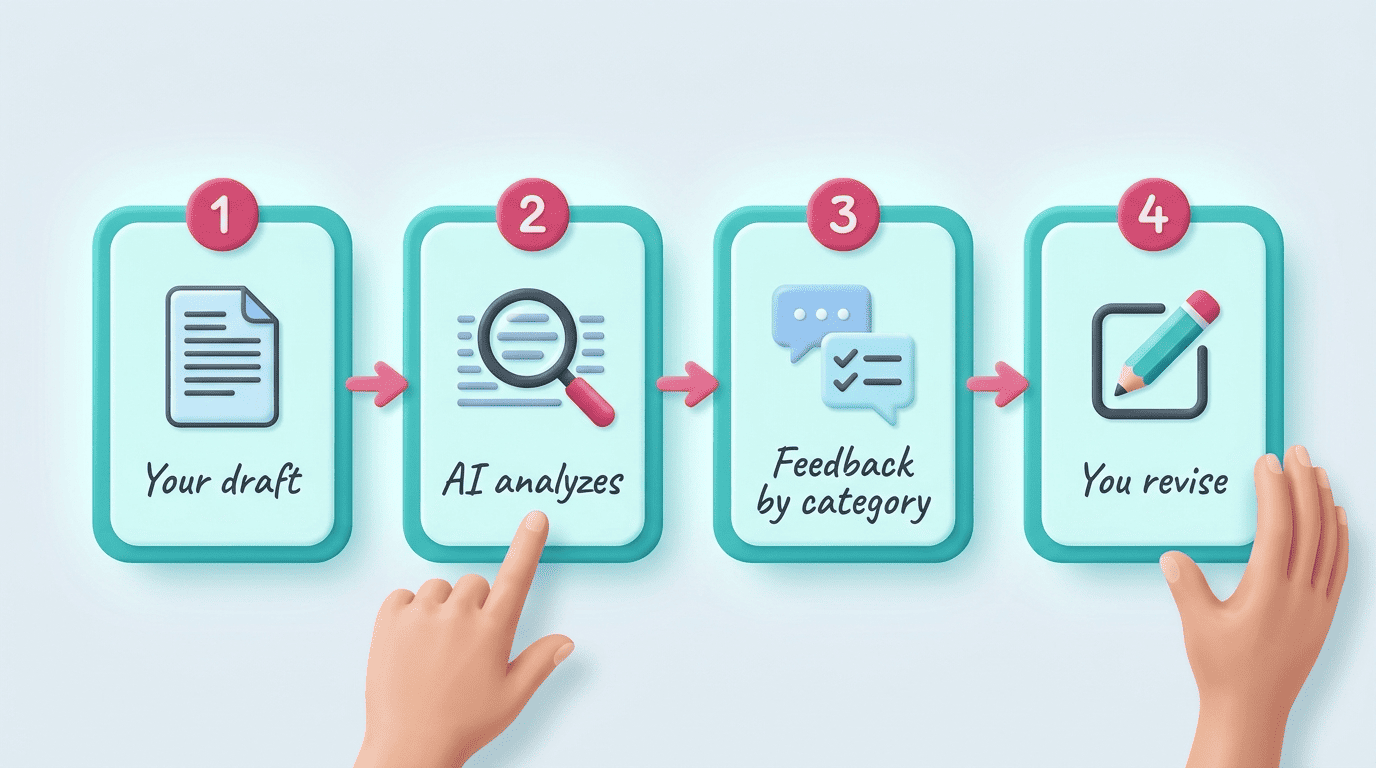
AI essay feedback is a category of automated essay scoring tools built to comment on a draft rather than replace it. You paste or upload a draft, and the tool analyzes it with natural language processing, then returns comments grouped by category instead of a rewritten version. The scoring models behind these tools trace back decades of research into automated essay scoring, which Wikipedia describes as “the use of specialized computer programs to assign grades to essays written in an educational setting” — evaluation, not composition.
From draft to feedback
Once you submit a draft, the system breaks it into components — thesis statement, paragraph structure, supporting evidence, sentence-level grammar — and scores or comments on each one separately. Some coaching tools go further and are explicit that they don’t provide content: they’ll ask you a question about a weak paragraph rather than supply a replacement sentence. That distinction between commenting and composing is what separates a feedback tool from a ghostwriting shortcut.
What it evaluates
Across most tools, feedback clusters into a similar set of categories. Some feedback platforms offer well over a hundred distinct feedback types spanning thesis, argument, evidence, grammar and style, while lighter-weight checkers stick mainly to grammar, punctuation, clarity and structure. Either way, the goal is the same: point at what to fix, not fix it for you.
- Thesis and focus — is the main claim clear and arguable?
- Structure and organization — do paragraphs build logically?
- Argument and evidence — does each claim have support?
- Clarity, grammar and style — are sentences correct and easy to follow?
- Rubric alignment — on more advanced platforms, does the draft match the assignment’s grading criteria?
| Feedback category | What it checks | Typical fix you make |
|---|---|---|
| Thesis / focus | Is your main claim clear and arguable? | Sharpen or narrow the claim |
| Structure / organization | Do paragraphs follow a logical order? | Reorder or add transitions |
| Argument / evidence | Does each claim have support? | Add a source, quote, or example |
| Clarity / grammar / style | Sentence-level correctness and flow | Rewrite awkward or unclear sentences |
| Rubric alignment | Does the draft match assignment criteria? | Address missing rubric points |
Is Using AI Essay Feedback Cheating? (Academic Honesty)
This is the question worth answering carefully, because the same tool can be used two very different ways.
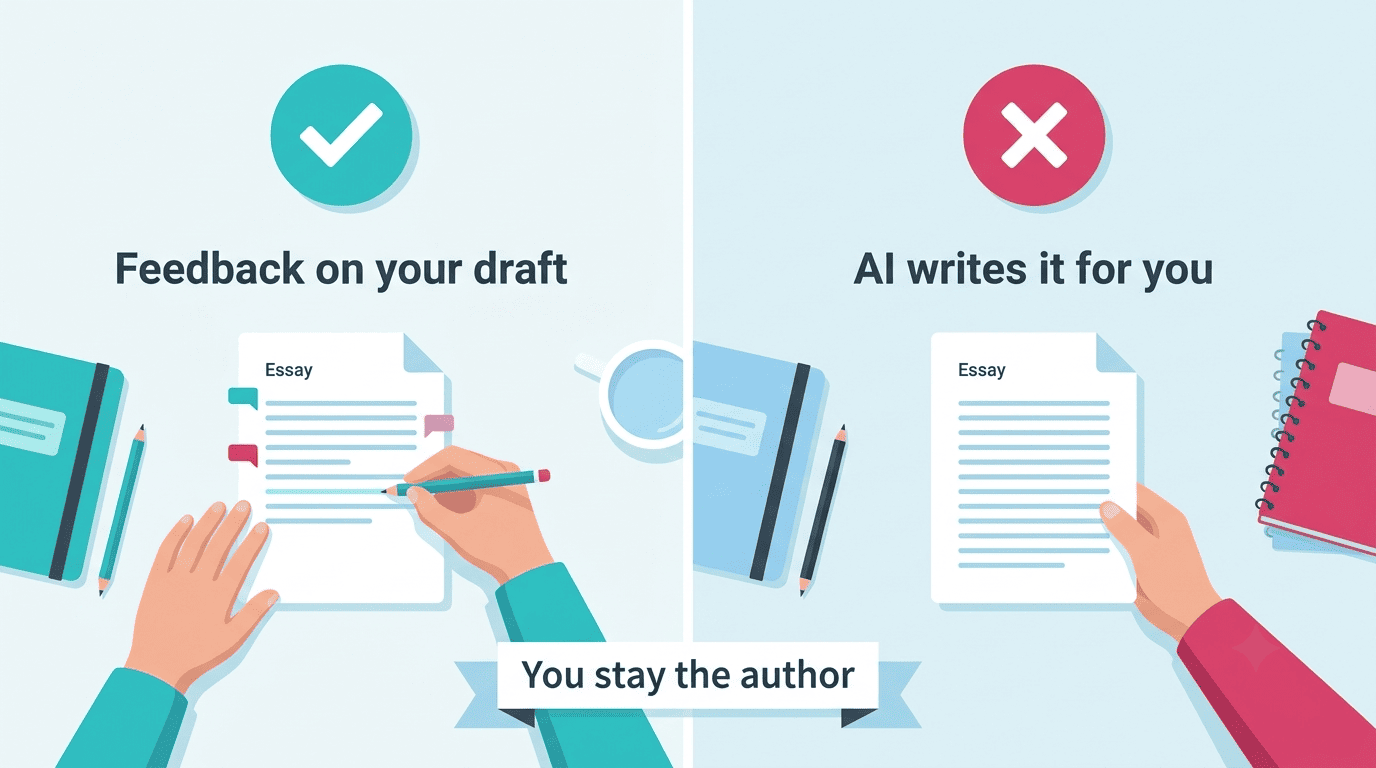
Feedback on your draft vs AI writing it for you
Draw the line clearly: asking AI to comment on a draft you wrote, and then revising it yourself, is legitimate — it’s the same kind of help a writing center tutor or a peer reviewer gives. Having AI write or rewrite the essay and submitting that as your own is academic dishonesty. The International Center for Academic Integrity defines academic integrity as “a commitment, even in the face of adversity, to six fundamental values: honesty, trust, fairness, respect, responsibility, and courage.” Submitting AI-generated prose as your own original work breaks that commitment, no matter how good the sentences sound. Notably, several of the more careful tools in this space are built around exactly this line — feedback-only, “never writes it for you” — which suggests the industry itself treats it as the safe boundary.
A few signals tell you whether a tool is actually built around feedback rather than ghostwriting:
- It responds with questions and comments, not rewritten paragraphs.
- It won’t generate an outline or draft from a blank prompt.
- Its marketing explicitly says it doesn’t write content for students.
- Any “suggested rewrite” feature is optional and clearly separate from core feedback.
Stay the author
You accept, reject, or adapt each suggestion — the words that end up on the page must be yours. The Purdue Online Writing Lab, one of the most widely cited university writing resources, frames revision as an author-driven process of rethinking structure and argument before ever touching sentence-level polish — a reminder that the thinking work of revision, not just the typing, belongs to the writer. Check your class and school policy on AI tools, and when in doubt, ask your instructor — some courses allow AI feedback, some don’t, and disclosure rules vary by school and even by assignment.
Academic integrity is a commitment, even in the face of adversity, to six fundamental values: honesty, trust, fairness, respect, responsibility, and courage.
International Center for Academic Integrity
How to Turn AI Feedback Into a Better Draft (Workflow)
Feedback is only useful if you have a repeatable way to act on it. Here’s a simple four-step loop that works with almost any AI essay feedback tool.
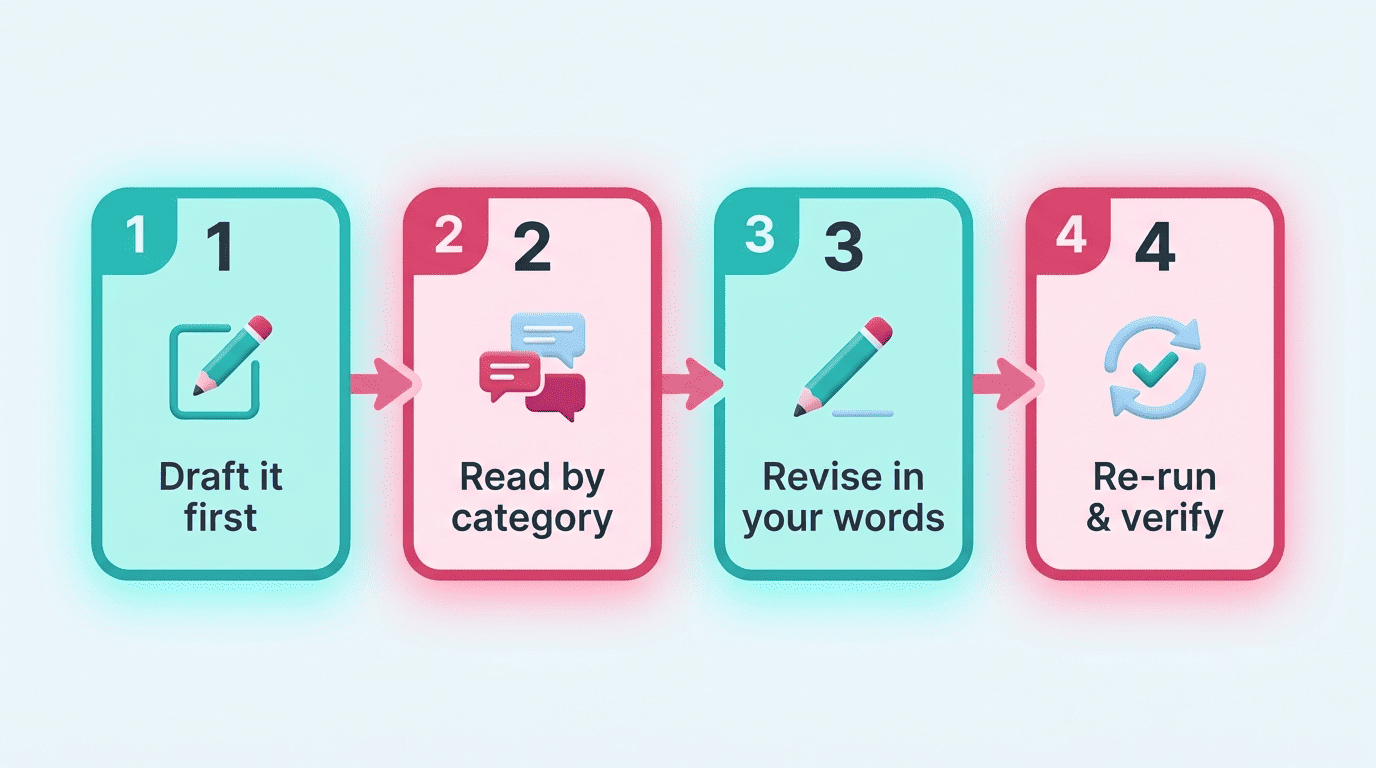
- Write your own draft first. Always feed the tool a complete draft you wrote, not a blank prompt asking it to generate one. Feedback only works on writing that already exists.
- Read feedback by category, not line by line. Fix big-picture issues first — thesis and structure — before grammar. If the tool supports it, paste in your assignment rubric so the feedback aligns to how you’ll actually be graded.
- Revise in your own words. Apply each note yourself; don’t paste AI-suggested sentences wholesale. For every suggestion, decide why you agree or disagree — that reflection habit is what separates real revision from copy-pasting fixes.
- Re-run and verify. Run the revised draft through the tool again for a second pass, then check the final version against your rubric and your own judgment before you submit.
Rubric-based feedback matters here: a tool that can align its comments to your specific assignment criteria is far more useful than one giving generic writing advice, because it tells you what your grader is actually looking for.
Accuracy: Can You Trust AI Essay Feedback?
Trusting the process doesn’t mean trusting every comment at face value.
Why you must double-check the feedback
Be blunt about the limits: AI can make mistakes — it can miss your argument’s real weakness, flag correct grammar as wrong, give generic praise, or misread your tone — so treat its feedback as a second opinion and double-check it against your assignment rubric and your teacher, not as a final grade. Automated scores are estimates of writing quality, not the grade your instructor will actually give, and formative feedback like this is meant to guide revision, not replace a teacher’s judgment.
What to verify
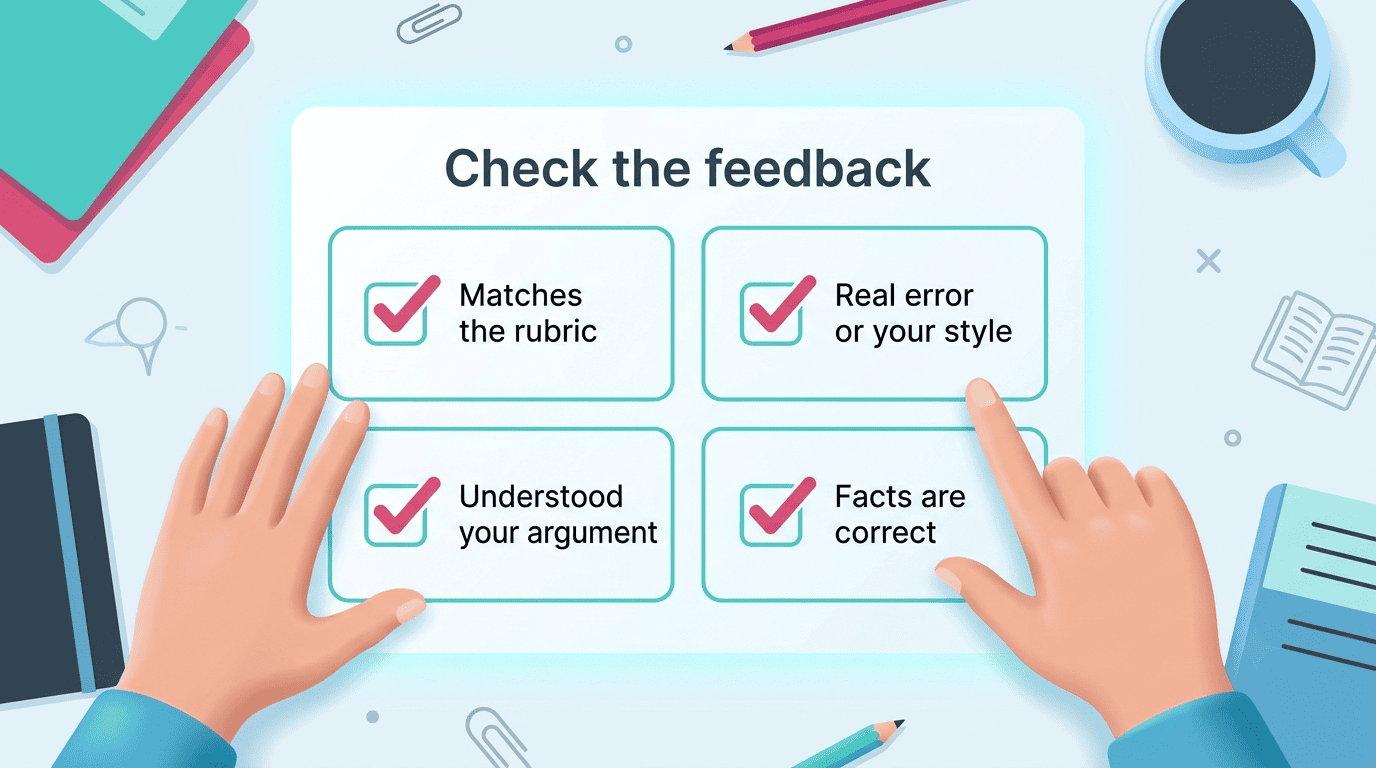
Before you act on any note, run it through a quick sanity check:
- Does the feedback actually match your assignment prompt and rubric, or is it generic advice?
- Is a flagged “error” really an error, or is it your intended style or voice?
- Did the tool understand your argument, or is it reacting to surface features like sentence length?
- If it comments on content or facts, are those facts actually correct?
Best AI Essay Feedback Tools (by Use Case)
Not every tool fits every situation — the right pick depends on what kind of essay you’re revising and who’s grading it.
| Tool type | Best for | Cost | Writes for you? |
|---|---|---|---|
| Free coaching tool | Everyday class essays | Free | No — guides, doesn’t write |
| Free grammar-first checker | Quick clarity/grammar pass | Free, unlimited | No |
| Rubric-aligned platform | College writing courses, LMS use | Paid, per-semester | No — 200+ feedback types |
| College-app specific | Personal statements, Common App | Varies | No — feedback only |
Free everyday feedback. For routine class essays, a free coaching tool that guides outlining, drafting and revising — with feedback on structure, clarity and evidence, and without writing content for you — plus a free grammar-focused checker with unlimited daily use cover most students’ basic needs.
College writing courses. Platforms built for course-level use often offer well over a hundred customizable feedback types across thesis, argument and evidence, integrate directly with learning management systems like Canvas, Blackboard or Moodle, and build reflection prompts into the workflow to keep students actively thinking about each suggestion rather than just accepting it.
College application essays. For personal statements and application essays, look for tools built specifically around Common App, Coalition and similar prompts that explicitly state they never write any part of the essay — functioning more like a counselor giving revision suggestions than a writer.
Pair whichever you choose with a broader ai learning tool so feedback feeds into notes, planning and self-testing across your work, not just one essay.
How to Choose the Right Essay Feedback Tool
A few criteria separate a genuinely useful tool from one that just flatters your draft:
- Does it give feedback beyond grammar — thesis, structure, evidence — or only surface-level corrections?
- Can it align its comments to your specific rubric, or is it generic?
- Is it feedback-only, or does it hand you finished sentences? The former keeps you honest; the latter creates risk.
- What are the free-tier limits, and what does the paid tier actually add?
- How is your draft’s privacy handled — is your unpublished work stored or used to train other models?
Flag the trap clearly: a tool that rewrites your essay for you creates an academic integrity risk, not a study aid, even if it feels like it’s saving time.
For most students the best setup is one ai study tool that reviews drafts, explains its notes, and helps you plan revisions in one place.